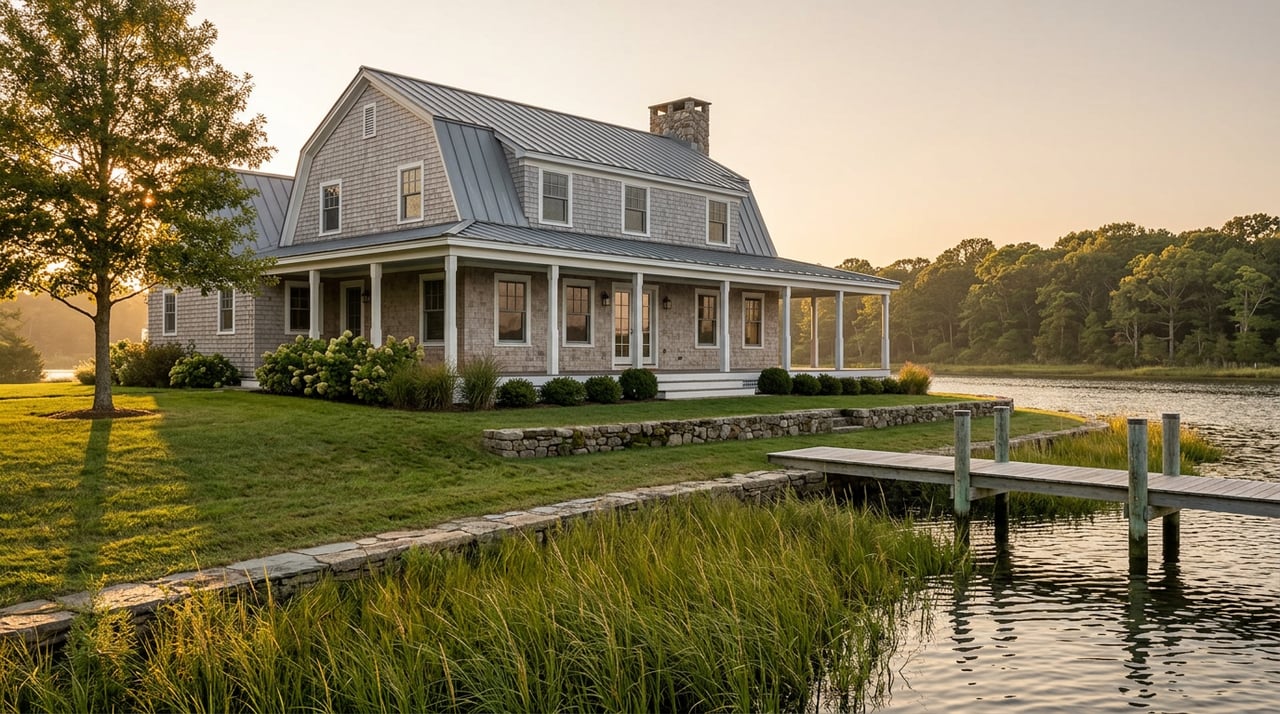
A house on the Connecticut River in Essex can look finished before the ink is dry. The dock is already built. The mooring ball is already bobbing in the cove. The listing photo shows a kayak pulled up on the bank like it belongs there. None of that tells you what actually transfers at closing.
In Essex, a waterfront address bundles together several separate rights that do not automatically move with the deed. The house is yours the day you close. The dock, the mooring, and the insurance number attached to that dock and mooring are governed by three different authorities, none of which asks what the listing sheet promised.
The Dock In The Photo May Not Be Yours To Keep
Connecticut law gives every waterfront owner a littoral right, the legal ability to reach navigable water from their own property. It does not give them ownership of the water itself, or a guarantee that whatever structure is currently sitting in it can stay exactly as built. The submerged land below the mean high water line belongs to the state, held in trust for public use, and the Department of Energy and Environmental Protection regulates what private structures are allowed to sit on top of it.
That regulation is specific. Under the state's Residential Dock Guidelines, a littoral owner gets one point of water access per property, and a dock is supposed to be centered on that owner's own frontage so it does not crowd a neighbor's rights. Docks built on easements are generally not permittable at all, because an easement does not create new littoral rights, only the underlying property does. If the seller's dock was ever repaired, expanded, or rebuilt without matching paperwork, that history follows the structure, not the sale price.
For a buyer, the practical question is not "does this house have a dock." It is "does this house have a dock the state has actually signed off on, and is that signoff still current."
The Harbor Master, Not The Seller, Controls The Mooring
A dock and a mooring are not the same asset, and Essex treats them differently. The town's Harbor Management Commission oversees more than 200 moorings in the harbor, a mix of private, commercial, and support moorings, along with the Main Street dock, the launch ramp, and Bushnell Access for small boat storage. Assignments run through an online system, and new applicants join a wait list, a process the town formalized in November 2022 with a modest, non-refundable application fee to hold a place in line.
That detail matters more than it sounds. A mooring assignment belongs to the person the harbor master assigned it to, not automatically to whoever buys the house on shore. Whether a mooring transfers with a sale, or whether the buyer starts over at the back of the wait list, is something to confirm during the offer stage, not after closing when the boat has nowhere to go for the season.
Three Agencies, One Dock
Any work on a dock, from a full rebuild down to a routine repair, can touch three separate layers of approval, and each one moves at its own pace.
| Layer | Who decides | What it covers |
|---|---|---|
| Town | Essex Harbor Management Commission and Harbor Master | Mooring assignments, wait lists, local harbor rules |
| State | Connecticut DEEP | Dock size and location relative to the mean high water line, general permit versus individual permit |
| Federal | U.S. Army Corps of Engineers | Structures near a federal navigation channel, dredging |
A dock that qualifies for the state's expedited general permit is capped at 220 square feet waterward of the mean high water line, with additional limits on length and depth. General permits are typically issued within 90 days of a complete application. Anything larger, or anything near a federal channel, moves into individual permit territory, where timelines stretch and the Army Corps gets a say alongside DEEP. None of that shows up in a property listing. It shows up the first time a new owner wants to add ten feet to a pier.
Fresh Water Meets Salt, And The Maintenance Bill Notices
The lower Connecticut River at Essex is tidal but not fully saline, a mixed freshwater and brackish estuary rather than a straight ocean coast. That mix changes what a dock, a boat lift, and the wiring that runs out to them are up against. Corrosion patterns and marine borer risk in a brackish tidal river differ from what a straight saltwater harbor produces, which is one reason marine contractors and coastal engineers inspect Essex docks, pilings, and bulkheads as a distinct category rather than treating them like generic waterfront hardware.
The cost of getting that wrong shows up after a storm, not before one. Restoration work on lower-river Essex properties in flood zones tied to North Cove and Foxboro Point often falls in the $8,000 to $50,000 range once brackish corrosion has reached electrical panels and HVAC components, a cost driver distinct from ordinary water damage. It is also not hypothetical history. The Falls River drainage through Centerbrook and Ivoryton was the site of a dam failure in June 1982, when roughly 15 inches of rain sent water down the valley into the mill villages below. Flood risk on this stretch of river has a documented past, not just a modeled future.
The Insurance Number Depends On A Document, Not Just A Zip Code
Every Connecticut municipality participates in the National Flood Insurance Program, and since FEMA's Risk Rating 2.0 overhaul, premiums are calculated on an individual property basis rather than a flat zone-wide rate. Replacement cost, distance to water, and foundation type all factor in, which means two similar-looking waterfront homes on the same cove can carry noticeably different premiums.
An Elevation Certificate, prepared by a licensed surveyor, is one of the few tools a buyer has to correct that number if FEMA's own data on the property is off. Coverage itself is capped at $250,000 for the structure and $100,000 for contents under a standard NFIP policy, and a new policy does not take effect for 30 days, which is worth building into a closing timeline rather than discovering the week before. Across a recent sample of nearly 200 Connecticut flood insurance transactions, residential premiums averaged around $2,200 a year, but individual deals ranged from under $1,000 to well over $50,000 depending on zone, elevation, and replacement cost. That spread is the whole story: the flood zone on a map gets a buyer in the door, but the elevation certificate is what sets the actual number.
One more detail worth knowing before touring an older waterfront property: if a renovation's cost reaches or exceeds half the structure's market value, it typically triggers a requirement to bring the entire building up to current flood construction standards, not just the portion being renovated. On a historic riverfront property, that threshold can arrive faster than a buyer expects.
What This Means If You're Comparing Homes By The Water
Along the Connecticut River corridor that includes Essex, homes with deeded dock rights and confirmed deep water access have been selling meaningfully faster than comparable homes without that documentation, while properties sitting in VE or high AE flood zones tend to list at a discount to offset the insurance cost a buyer will absorb later. Recently renovated waterfront homes carry a premium over places that still need work, which tracks with everything above: buyers are pricing in the paperwork, the permits, and the corrosion risk, whether they realize it or not.
In Essex Village specifically, waterfront inventory has stayed thin, with listings typically moving within about a month once priced correctly. That pace rewards a buyer who has already confirmed the mooring situation and pulled the flood zone history before writing an offer, and it punishes one who assumes the dock in the photo is simply included.
None of this is a reason to avoid the river. It is a reason to ask different questions than the ones the listing photo answers. What matters is not whether the house touches water. It is whether the mooring transfers, whether the dock's paperwork is current, and whether the flood insurance quote reflects the actual elevation of the actual building, not a zone-wide guess.
That is the kind of detail Nancy Mesham and her team walk through with every waterfront buyer and seller in Essex, because the river doesn't change what the house is worth. It changes what the house actually includes.
What Is My Home Worth?
A Few Questions Worth Asking Before You Tour
Does a mooring automatically come with the house? Not necessarily. Essex assigns moorings through the Harbor Master and Harbor Management Commission, and transfer rules should be confirmed with the town before the offer is finalized, not after closing.
How long does dock permitting actually take? A dock that qualifies for the state's general permit is often approved within about 90 days of a complete application. Anything larger, or anything near a federal channel, can take considerably longer once the Army Corps of Engineers is involved.
Is flood insurance required on every waterfront property in Essex? It is generally required by lenders for properties in a Special Flood Hazard Area with a federally backed mortgage. Even outside that zone, it is worth pricing, since a meaningful share of flood claims nationally come from homes that were never mapped as high risk in the first place.